

Getting your affairs in order: key takeaways from our free estate planning session
On Wednesday 14 October 2026, VF Legal and Community Bank Freshwater hosted a free community information session, A guide to smart estate planning, in the Freshwater Room at Harbord Diggers.
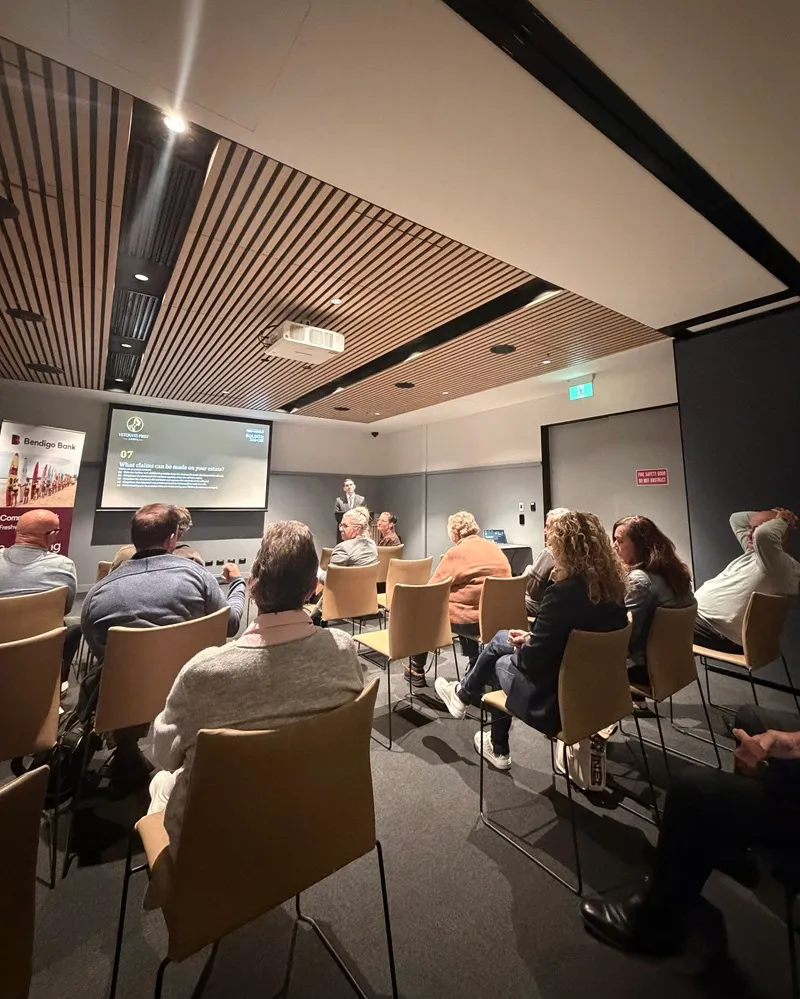
Practice Director Susan Dalliston opened the evening by sharing how VF Legal is invested in the community, including through our annual contribution to Soldier On, which supports veterans and their families. Kasey Kaye, Branch Operations Manager at Community Bank Freshwater, shared what happens with bank accounts when someone dies or loses capacity. VF Legal’s estate specialist, Jamie Cklamovski, explained the elements of a good estate plan, why powers of attorney matter, and how to reduce the risk of a dispute over your estate.
Thank you to Community Bank Freshwater for partnering with us to bring this session to the community, to Harbord Diggers for hosting us, and to everyone who came along and asked such thoughtful questions. For those who couldn't make it, here are the key points from the evening.
What is estate planning?
Estate planning is deciding how your assets, responsibilities and wishes will be handled if you lose capacity or pass away. A comprehensive plan protects you and your loved ones, reduces legal complications and tax, and makes sure your intentions are honoured.
Without one, you may be handing control of your affairs to others: people you might not choose, the NSW Trustee and Guardian, or the courts.
In NSW, a good estate plan is built around your circumstances, assets and goals. It typically includes:
- an enduring power of attorney
- an appointment of enduring guardian
- a will
- a superannuation death benefit nomination
- arrangements for who controls your family trust(s), and business succession where relevant.
Power of attorney and enduring guardian: what's the difference?
These two documents are often confused, but they cover different parts of your life. Together, they let people you trust step in if you can no longer make decisions for yourself.
Enduring power of attorney
- Covers - Financial and legal decisions
- Examples - Operating bank accounts, signing contracts and leases, lodging tax returns
- When it operates - A general power works only while you have capacity; an enduring power continues after you lose capacity
- Who you can appoint - One or more attorneys, often family members
Appointment of enduring guardian
- Covers - Health and lifestyle decisions
- Examples - Where you live, the health care and personal services you receive, consent to medical and dental treatment
- When it operates - Only once you are no longer able to make these decisions yourself, such as through dementia or serious illness
- Who you can appoint - One or more guardians, often family members
Two things are worth knowing. Once you die, the power of attorney and enduring guardianship are no longer relevant and your will is the only relevant document. You can only create those documents if you have mental capacity, so the time to act is now.
What happens if you don't have them?
If you lose capacity without these documents, your family may not be able to step in the way you'd expect. Your next of kin can make some immediate decisions, such as at a hospital, but this can lead to disagreements between a spouse, children and other relatives. They cannot make decisions about your assets or where you live.
Instead, anyone with a genuine concern for your welfare can apply to the NSW Civil and Administrative Tribunal (NCAT) for guardianship and financial management orders. The Tribunal may appoint someone you would not have chosen. Where there is family conflict, it may appoint the NSW Trustee and Guardian, which can charge an ongoing commission for managing your estate. While a dispute plays out, your assets may be wasting away.
The simple fix is to see a lawyer and put an enduring power of attorney and enduring guardianship in place. Over the counter will kits and AI generated wills often create problems down the track.
What happens at the bank when someone dies
Kasey Kaye from Community Bank Freshwater explained what families can expect at the branch:
- Joint accounts pass to the surviving account holder.
- Accounts in the deceased's sole name are frozen, and no one can access the funds. The exception is a funeral invoice, which the bank can pay directly to the funeral home.
- A power of attorney ends on death, and the bank removes the attorney from the accounts.
- Bring original documents. Many people arrive with only copies of a will or power of attorney, but the bank needs to see originals.
- Check your credit cards. A card many couples think is joint is often in one partner's name, with the other only a signatory. When the cardholder dies, the surviving partner can lose access to credit, and getting a new card in retirement can be hard.
- Executors usually need an estate account to manage the estate's money during probate.
What claims can be made on your estate?
Even a valid will can be challenged. The most common claims are:
- Family provision claims. Under the Succession Act 2006 (NSW), an eligible person can ask the Court for adequate provision for their "proper maintenance, education or advancement in life". Eligible people include a spouse or de facto partner, a former spouse, children, certain dependent grandchildren or household members, and a person in a close personal relationship with you. A claim can be made regardless of what you gave them during your life, and the Court looks at factors such as their future needs.
- Capacity and "knowledge and approval" challenges. These argue you lacked capacity, or didn't understand or approve your will, when you signed it. They are increasingly common with an ageing population, more dementia and high property values.
- Undue influence. An allegation that you were pressured into making the will.
- Promissory estoppel. A claim to enforce a promise you made during your lifetime, often called "farm cases", such as promising a child the farm if they work the land. The Court can enforce that promise whatever your will says.
The Court has wide powers, including lump sum orders, transfers of assets, periodic payments and notional estate orders.
How to protect your estate
- Have your will and estate plan professionally drafted. Skip the will kit and the AI tool. A solicitor can assess your capacity, keep a file note and give evidence if your will is later challenged. Without that, there may be no evidence that you had capacity and understood your will. As Jamie noted in the Q&A, a short letter from a GP is often not enough; where capacity may be questioned, a proper assessment and report from a specialist carries far more weight.
- Act sooner rather than later. Update your will while your capacity is not in doubt.
- Consider a section 100 statement. If you expect a claim, a written statement of your reasons for how you've divided your estate can be taken into account by the Court.
- Document care arrangements. If you or an elderly parent has a regular carer, a written, paid arrangement helps show it is a commercial relationship, not a personal one.
- Be careful what you promise. Australian courts can and will enforce promises about your estate. If you make an arrangement, put it in writing with advice.
Talk to your local legal team
Based in Manly, VF Legal supports individuals, families and businesses across the Northern Beaches with clear advice and practical support for life's important decisions. Our firm is a proud partner of Soldier On, contributing every year to support veterans and their families. Our doors are open to everyone.
If the session prompted you to review your will, powers of attorney or super nominations, speak with a lawyer today on 02 9098 0000, email info@vflegal.com or visit us at Unit 7, 2C Darley Road, Manly.
This article is general information only and is not legal advice. Please seek advice about your own circumstances.
Written by

Ready to Discuss Your Situation?
Our team is here to help you understand your options.
Explore More Resources

Family trusts and succession planning: what may change under the 2026–27 Federal Budget?

Will “Contact Agent” become less common? NSW underquoting reforms explained
